


The lessons of the Holocaust figure prominently in FSWC’s education programs that promote the principles of inclusion, social justice and democratic values. In addition to the important historical facts behind Nazi Germany’s murder of six million Jews, we bring this dark chapter to life through the Holocaust survivor testimonies of those who, against all odds, survived the genocide.
Since the inception of FSWC, Holocaust survivors have discussed the horrors of concentration camps at our educational workshops and events. We are deeply grateful for their participation and for their strength in sharing their difficult personal journeys with young people, with the hope it will help prevent such a horrific tragedy in the future.
We are honoured to introduce you to some of the incredible men and women who have given so much of their time to contribute greatly to Holocaust education in Canada. The short summaries below and accompanying videos offer only a brief glimpse into the lived experience of antisemitism and trauma each of these people endured in their younger years duirng Holocaust.
Sadly, with the number of survivors constantly diminishing, the day is fast approaching when there won’t be anyone left who can give first-hand testimony of the excruciating reality Jews faced under the Nazis. All the more reason it is imperative to forever preserve and revisit these stories as part of the legacy of survivors.
Before the Second World War, the Netherlands was home to around 140,000 Jews. Many Dutch Jews had lived in the country for generations, while around 30,000 were refugees from Germany and Austria. In 1940, the Netherlands was invaded and occupied by Nazi Germany. Under Nazi rule, antisemitic laws quickly restricted freedoms for Dutch Jews, including expelling Jewish professionals from their jobs and forcing Jews to wear the yellow star of David on their clothing.
Beginning in 1942, the Nazis arrested Jews across the Netherlands, deporting them to the transit camp at Westerbork, the Netherlands, before they were transported by train to concentration camps and extermination centers like Auschwitz and Sobibor. Over 75% of Dutch Jews were murdered during the Holocaust, the highest rate of any community in Western Europe. Many of those who survived were able to evade arrest through the help of the Dutch underground or ordinary citizens, who hid Jewish people or helped them to obtain false papers.
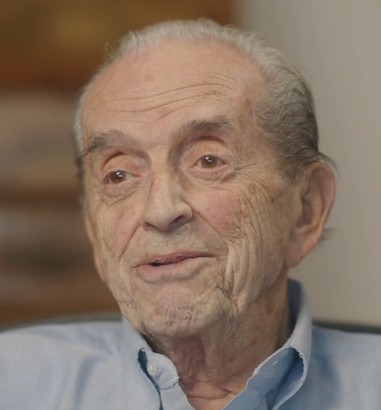
Leonard was born in 1930 to a middle-class Jewish family in Amsterdam, the Netherlands. He had two younger siblings, a sister and a brother. His family had lived in the Netherlands since before the French Revolution. Leonard describes his family as Emancipated — that is, assimilated into wider Dutch society. Though Leonard’s family were integrated into Dutch life, they were still religiously observant, or “Modern Orthodox”, attending synagogue every Saturday. Leonard’s father was a salesperson representing a number of factories. Leonard enjoyed a normal life before the war, going to school and pursuing philately, or stamp-collecting, as a hobby.
September 16th, 1930 – Leonard is born in Amsterdam.
May 17th, 1940 – The Germans invade and occupy the Netherlands.
December 1941 – A neighbour, “Uncle Bill”, offers to help Leonard’s father to hide his family and protect them from deportation.
August 1942 – Uncle Bill helps the family to go into hiding; Leonard is separated from his parents and hidden in a shack.
Winter 1942 – Leonard is moved from the unheated shack to the house of a Dutch family who were hiding a total of 28 people.
September 30th, 1943 – Leonard and his group are caught by the Dutch police and taken to jail in Haarlem.
October 2nd, 1943 – Leonard is transported to a collection point for deportation; meeting family friends there, they advise him to avoid registering and make his escape.
October 9th, 1943 – He flees from the train deporting him to Westerbork transit camp and goes back into hiding with a Dutch family.
1945 – Leonard is able to come out of hiding as the Netherlands is liberated.
1. How can the story Leonard tells about hating broccoli help us think differently about hate and discrimination?
2. In his testimony, Leonard says “a name is one of our holiest possessions”. What do you think he means by this? What does Leonard say about names and the Holocaust in his testimony?
3. Why do you think it was so important for Leonard’s father to give him a Jewish prayer book, and why do you think Leonard decided to discard it?
4. Leonard says he hasn’t really overcome his anger but tries to give it a positive spin by sharing his story. How do you think experiences of loss and trauma can shape a person’s life long-term? How can sharing difficult experiences be a way to heal or from these experiences?
5. How do you think Leonard’s experience of going into hiding at such a young age affected his sense of identity and independence
Actors during the Holocaust
- In his testimony, Leonard describes five actors, or types of people, during the Holocaust: the Perpetrator, the Victim, the Rescuer, the Bystander, and the Propagandist
- Describe each of these five actors: what did they do? Why? What factors influenced their beliefs and decisions?
- Using Leonard’s testimony, identify individuals in his story who align with these five groups.
- (Optional) do further research into the actions of these groups during the Holocaust in the Netherlands and elsewhere.
Letter to Leonard
- Write a one-page letter to Leonard reflecting on his testimony and what you learnt from it.
- You may want to express your feelings about his testimony, share something that stood out to you, or connect his story to something from your own life or another event or experience you know of.
- In your letter, be sure to ask Leonard questions about his experiences and perspectives.


Copyright © FSWC. All Rights Reserved.


