


The lessons of the Holocaust figure prominently in FSWC’s education programs that promote the principles of inclusion, social justice and democratic values. In addition to the important historical facts behind Nazi Germany’s murder of six million Jews, we bring this dark chapter to life through the Holocaust survivor testimonies of those who, against all odds, survived the genocide.
Since the inception of FSWC, Holocaust survivors have discussed the horrors of concentration camps at our educational workshops and events. We are deeply grateful for their participation and for their strength in sharing their difficult personal journeys with young people, with the hope it will help prevent such a horrific tragedy in the future.
We are honoured to introduce you to some of the incredible men and women who have given so much of their time to contribute greatly to Holocaust education in Canada. The short summaries below and accompanying videos offer only a brief glimpse into the lived experience of antisemitism and trauma each of these people endured in their younger years duirng Holocaust.
Sadly, with the number of survivors constantly diminishing, the day is fast approaching when there won’t be anyone left who can give first-hand testimony of the excruciating reality Jews faced under the Nazis. All the more reason it is imperative to forever preserve and revisit these stories as part of the legacy of survivors.
In 1939, around 3.3 million Jews lived in Poland, making it home to Europe’s largest Jewish community. In 1939, Nazi Germany invaded Poland, and the country was split between Germany and the USSR, which occupied its eastern half. Ghettos were established in cities across Poland, including Lodz and Warsaw. Ghettos were closed areas in which Jews were required to live; conditions in the ghettos were brutal, with overcrowding and malnutrition common. Thousands died of disease, starvation or mistreatment in the ghettos.
After the Nazi invasion of the USSR in 1941, the entire country came under Nazi control, and would become the epicenter of the Final Solution. In 1942, the Nazis began deporting Jews from the ghettos to concentration camps and killing centers including Auschwitz and Treblinka. Most deportees were gassed on arrival, while others were used as forced labour in the Nazi concentration camp system. In 1943, the surviving inhabitants of the Warsaw ghetto rose up against the Nazis; though brutally suppressed, the uprising — and others like it across Poland — stands as a powerful symbol of Jewish resistance during the Holocaust. Ultimately, about 90% of Poland’s pre-war Jewish population were murdered during the Holocaust, and most of the survivors never returned to their prewar homes.
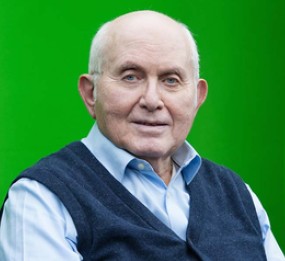
Pinchas Gutter was born in 1932 in Lodz, Poland. Of the 750,000 inhabitants, about 1/3 were Jewish before the Second World War. Pinchas’ family were very religious Hasidic Jews, and Pinchas received a traditional Jewish education. Though part of a large extended family, Pinchas only had one sibling — his twin sister. His parents were winemakers, a profession Pinchas’ ancestors had practised for four hundred consecutive years. Pinchas characterises his childhood as a happy one, despite some experiences of antisemitism from his Polish neighbours as a young boy.
1932: Pinchas and his twin sister are born in Lodz.
September 1939: Nazi Germany invades Poland; Pinchas and his family flee from Lodz to Warsaw.
November 1940: Pinchas and his family are imprisoned in the Warsaw Ghetto.
July 22, 1942: Deportations from the ghetto to Treblinka extermination center begin.
April 19, 1943: the Warsaw Ghetto Uprising begins; Pinchas’ family hides in a bunker underground.
Early May 1943: After hiding for three weeks, Pinchas and his family are discovered by the Nazis and deported to Majdanek.
Summer 1943: After three months in Majdanek, Pinchas is sent to do slave labour at an ammunition factory.
July 1944: Pinchas survives a selection at the factory thanks to a Jewish camp policeman whose wife he had nursed.
May 1945: Pinchas is liberated by the Red Army at Theresienstadt.
1. What factors helped Pinchas to survive during the Holocaust?
2. What does Pinchas’ testimony teach you about the Holocaust? Does it change your existing understanding of what happened during the Holocaust?
3. What role does resistance play in Pinchas’ testimony?
4. What does Pinchas’ testimony tell us about collaborators during the Holocaust?
5. Pinchas lost many family members and friends during the Holocaust. What do his memories and descriptions of these losses tell us about the impact this had on Pinchas?
1. Timeline project
a. Using Pinchas’ testimony, put together a visual timeline tracing his journey during the Holocaust
b. Students would identify key events in Pinchas’ life and create a timeline (either physically or digitally) illustrating his experiences
c. The timeline should include descriptions, dates, and maps or images
2. Creative writing project
a. Choose a moment from Pinchas’ story (e.g. the Warsaw Ghetto Uprising, the liberation)
b. Write a diary entry from his perspective, explaining his experiences, thoughts, and feelings.
c. Optional follow up-discuss the role of personal narratives in helping us to understand the history of the Holocaust


Copyright © FSWC. All Rights Reserved.


