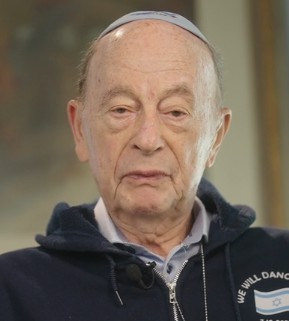
The lessons of the Holocaust figure prominently in FSWC’s education programs that promote the principles of inclusion, social justice and democratic values. In addition to the important historical facts behind Nazi Germany’s murder of six million Jews, we bring this dark chapter to life through the Holocaust survivor testimonies of those who, against all odds, survived the genocide.
Since the inception of FSWC, Holocaust survivors have discussed the horrors of concentration camps at our educational workshops and events. We are deeply grateful for their participation and for their strength in sharing their difficult personal journeys with young people, with the hope it will help prevent such a horrific tragedy in the future.
We are honoured to introduce you to some of the incredible men and women who have given so much of their time to contribute greatly to Holocaust education in Canada. The short summaries below and accompanying videos offer only a brief glimpse into the lived experience of antisemitism and trauma each of these people endured in their younger years duirng Holocaust.
Sadly, with the number of survivors constantly diminishing, the day is fast approaching when there won’t be anyone left who can give first-hand testimony of the excruciating reality Jews faced under the Nazis. All the more reason it is imperative to forever preserve and revisit these stories as part of the legacy of survivors.
Sol was born in Poland, which had a Jewish population of over 3 million in 1939. In September of that year, the country was divided by the coordinated simultaneous invasions of Nazi Germany from the west and the USSR from the east. The USSR then annexed eastern Poland, including parts of modern‑day Ukraine and Belarus. While some Jewish residents were initially hopeful that the Soviet regime would be a lesser evil than the Nazis, the Soviet regime was harsh, suppressing Jewish religious and cultural life and eliminating civil liberties. Indeed, under Soviet occupation, hundreds of thousands of Polish citizens — including many Jews — were deported to Siberia and Central Asia. Sol and his family were among these deportees. Life in the Soviet labour camps was harsh, with poor living conditions, overcrowding, and brutal winters.
In June 1941, Nazi Germany launched Operation Barbarossa, invading Soviet‑held Polish territory and bringing it under Nazi control. This marked the beginning of the Holocaust in this part of Poland, whereby Einsatzgruppen, or mobile killing units, carried out mass shootings of Jews across the region. Jewish communities not murdered by the Einsatzgruppen were then forced into closed ghettos, where living conditions were appalling and death by starvation, disease or violence was common. Beginning in 1942, Jews from these ghettos were deported to concentration camps and killing centers such as Belzec and Sobibor. The vast majority of Jewish people living in the eastern half of Poland in 1941 were murdered in the Holocaust, with about 90% of Polish Jews being killed altogether.
Sol was born in Stoczek Węgrowski, a small town in Poland about 45km from Warsaw. He was the second child of Sarah Rose Rosenberg (b. 1904) and Yudel Nayman (b. 1905), who married in 1927 — his sister, Manya, was seven years older. Sol’s maternal grandfather, for whom he was named, was a Sofer — a scribe of Jewish texts. His maternal grandmother ran a market stall selling foodstuffs. Sol grew up in a small wooden house and though the family was not well‑off, he enjoyed a happy, close‑knit childhood and his family maintained relationships with cousins who had emigrated overseas. His community was politically active, with his father choosing to join the Bund, a Jewish socialist party.
November 5th, 1935: Sol is born in Stoczek Węgrowski, a small town of 2000 inhabitantsin Poland.
September 1st, 1939: Nazi Germany invades Poland.
September 9th, 1939: Sol and his family flee from the destruction of their town by the Nazis, settling in Bialystok, Soviet-occupied Poland.
Late 1939: Sol and his family are deported from Bialystock to Syktyvkar, near the Uralmountains in the USSR.
June 22nd, 1941: Nazi Germany invades the USSR.
Spring 1945: the war ends and Sol’s family moved to Boża Góra, in Lower Silesia, Soviet occupied Germany.
Summer 1946: Sol’s family move to a tent city for refugees in the American zone, southern Germany.
October 1948: Sol’s family emigrates to Canada.
1. Why does Sol emphasize the importance of education, especially Holocaust education,in preventing future hatred and genocide? What lessons do you think students today can learn from his experiences?
2. Why did Sol find it so difficult to identify himself as a Holocaust survivor?
3. Sol says, “No survivor ever survived alone”. What do you think he means by that? What examples can you find in his testimony which reflect that idea?
4. What factors led Sol’s family to decide to emigrate to Canada after the war?
5. Sol says, “Nothing educates like being where it happened.” Why do you think visiting historical sites like Auschwitz and Treblinka can have such a strong impact on people? What do such visits teach
1. Mapping Sol’s journey
a. Using a digital or physical map, ask students to identify and label the key locations from Sol’s life
b. For each location, add a short description of what happened to Sol there
c. Reflect as a class on the themes of the journey (e.g. immigration, deportation, liberation)
2. Objects
a. Create a list of the objects and items Sol mentions in his story (e.g. his white rocking horse, the maroon duvet)
b. Create a poster describing each object and its role in Sol’s story
c. As a class, reflect on the place of objects in Sol’s testimony and how we can teach and learn about the Holocaust by using objects and personal possessions


Copyright © FSWC. All Rights Reserved.